Milton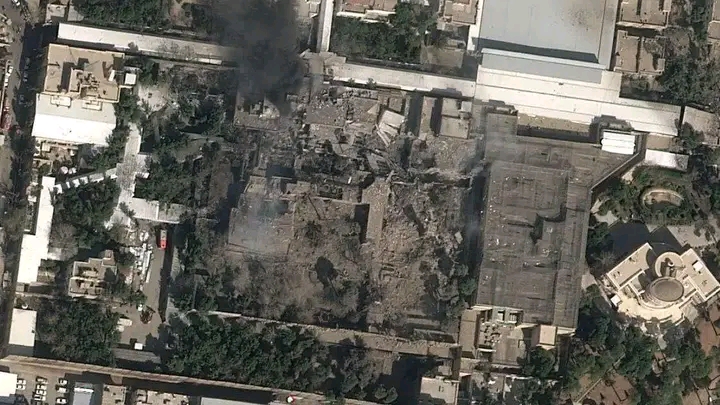
They waited until Iran’s entire ruling echelon — the Supreme Leader, the President, and senior military commanders — were physically co-located in the same room. Then they struck.
This was not impulsive. It was the result of months of intelligence preparation: layered surveillance, signal intercepts, human sources, and pattern analysis focused on one variable — timing — the moment Iran’s top leadership was together. That moment came at 8:15 a.m. in broad daylight.
Previous Israeli operations struck under cover of darkness — June 2025 assaults at night, October 2024 attacks after midnight. Iran’s air defenses are doctrinally tuned to night incursions. This time was different — not infrastructure, but a leadership meeting was the objective.
Multiple international outlets confirm that strikes hit the gathering linked to Supreme Leader Ali Khamenei and President Masoud Pezeshkian, and that the operation was planned jointly by Israel and the United States over months. Iranian state media reported explosions in Tehran and other cities as coordinated attacks unfolded. 
The most consequential unknown now is simple:
Was the Supreme Leader relocated before the strike, or did he survive being present in the room?
If he was moved in advance, it implies a leaking of precise location and timing from inside Iran’s inner circle. If he was there and survived, it means the strike successfully hit the target room. Both scenarios shatter internal regime security assumptions.
Iran’s leadership now knows three things with chilling clarity:
- Israel (and its U.S. partner) knew where they were meeting.
- They knew when they were meeting.
- They knew who would be in the room.
All of the pre-positioning — advanced air assets, tanker deployments, flights, and logistics — aligns with delivering one precision strike on one concentrated target.
From here, every future senior meeting carries a single interrogative:
Does Israel know about this one too?
This is not merely a military campaign. It is the destruction of institutional trust inside a tightly controlled regime. A hierarchy paralyzed by the fear that its own advisors or security apparatus may have betrayed them is a hierarchy facing internal collapse.
Every general sitting with Khamenei tomorrow will wonder who told Jerusalem about today. Every IRGC commander summoned to a briefing will calculate whether attendance is duty or a death sentence. Every so-called secure facility in Tehran has now been proven insecure.
In contrast to June 2025 — when strikes eliminated dozens of senior officers across dispersed targets — this was a scalpel, not a hammer. One meeting. One moment. Months of patience and planning. 
The Regional Backlash and Gulf Coalition Against Iran
Iran’s retaliation was swift: ballistic missile and drone barrages were launched toward multiple states across the Middle East, including Israel and U.S. military bases in Kuwait, Bahrain, Qatar, Saudi Arabia, and the UAE. Sirens blared, air defenses engaged, and shrapnel from intercepted missiles killed at least one civilian in Abu Dhabi. 
The response from Gulf Arab states marked a strategic geopolitical shift. Saudi Arabia, the United Arab Emirates, Kuwait, Bahrain, Qatar, and Jordan publicly condemned Iran’s missile attacks, denouncing them as violations of sovereignty and affirming solidarity with one another’s security. Riyadh pledged to place “all its capabilities” at the disposal of regional defense against future Iranian aggression — effectively birthing a de-facto coalition of Gulf states aligned in opposition to Tehran’s strikes. 
This coalition represents a historic rupture: states that had maintained varying degrees of hedging, neutrality, or cautious engagement with Iran now find common cause in resisting Iranian military action. Rather than isolating Israel and the United States, Iran’s retaliatory moves have accelerated a broader Arab alignment that perceives Tehran as the immediate threat to regional stability.
Strategic Consequences
What has been traded is clear:
• Israel achieved a concentrated strategic hit in exchange for the permanent erosion of Iran’s internal security assurances.
• Iran’s retaliation catalyzed a united Gulf front, not against Israel, but in opposition to Iranian strikes across Arab territory.
That is not a battle.
That is checkmate disguised as a first move — structurally undermining Iran’s command cohesion and catalyzing a new regional security architecture.