Milton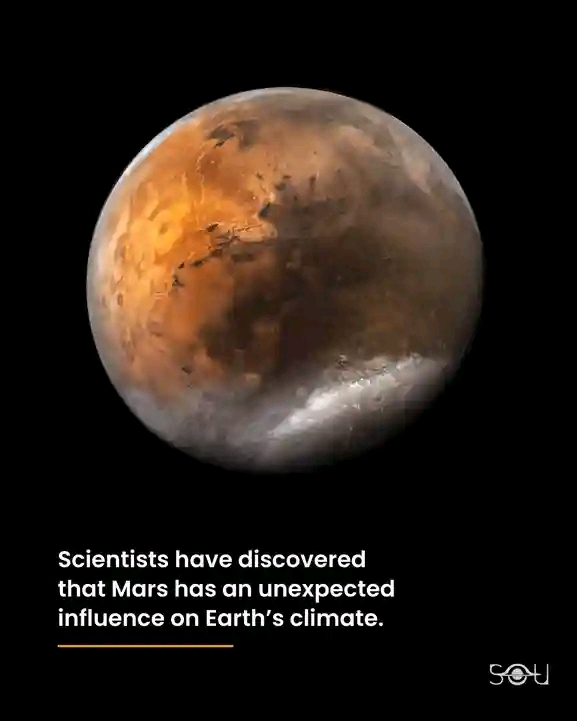
A new dynamical study shows that Mars, despite being only about one-tenth Earth’s mass, is a surprisingly important architect of our planet’s Milankovitch cycles—the slow variations in orbital shape and axial tilt that drive ice ages and warm intervals over tens of thousands to millions of years. By systematically tweaking Mars’s mass in high-precision N-body simulations, the team revealed just how deeply Earth’s seasons are entangled with its planetary neighbor.
Using numerical integrations that included all eight planets and varied Mars’s mass from effectively zero up to ten times its current value, the researchers tracked how Earth’s eccentricity, axial tilt, and orbital orientation evolved over millions of years. The familiar 405,000-year eccentricity “metronome,” mainly set by Venus and Jupiter, remained rock-steady in every run, but shorter ~100,000-year cycles—key to pacing ice ages—grew longer and more powerful as Mars became more massive.
The most striking result is the 2.4-million-year “grand cycle”: it vanishes when Mars’s mass is dialed down near zero and only emerges when the red planet is hefty enough to lock Earth into the right gravitational resonance. Earth’s 41,000-year obliquity cycle also stretches to 45,000–55,000 years in simulations where Mars is ten times heavier, radically reshaping patterns of ice-sheet growth and retreat.
These insights not only reframe Earth as a product of the entire inner Solar System, but also sharpen how scientists judge the long-term climate stability—and potential habitability—of Earth-like exoplanets with nearby planetary neighbors. Future work will fold these interactions into climate models and exoplanet mission strategies to better identify worlds where orbital architecture favors life over deep time.
📄 RESEARCH PAPER
📌 Stephen R. Kane et al., “The Dependence of Earth Milankovitch Cycles on Martian Mass”, Publications of the Astronomical Society of the Pacific (2025)