Milton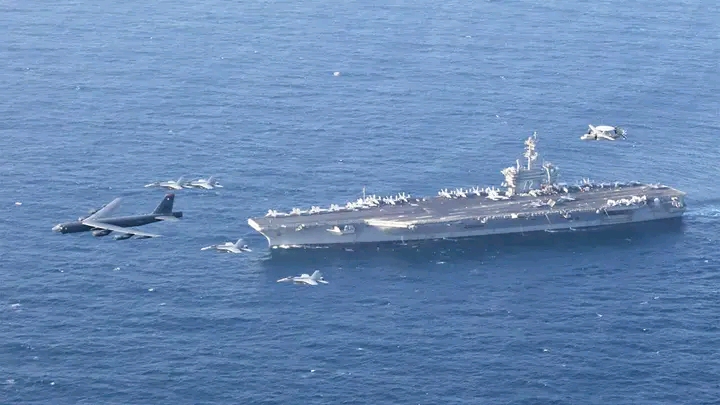
Satellite imagery has confirmed that the United States has conducted a major military buildup near Iran over the past month, deploying aircraft carrier strike groups, warships, and dozens of combat aircraft across the Middle East.
(local time), citing satellite analysis and U.S. Department of Defense officials, that the U.S. military has deployed dozens of fighter jets and at least 12 naval vessels, including aircraft carriers, into Middle Eastern waters.
The deployment is widely interpreted as a move by U.S. President Donald Trump to demonstrate overwhelming military superiority while negotiations with Iran remain underway.
While the scale of the current deployment is smaller than the force assembled during U.S. strikes on Iranian nuclear facilities in June last year, the report noted that further military reinforcements are likely in the coming days.
According to the report, the Nimitz-class aircraft carrier USS Abraham Lincoln, accompanied by three destroyers, entered the U.S. Central Command (CENTCOM) area of responsibility on the 26th of last month and is currently operating in the northern Arabian Sea.
This marks the first deployment of a U.S. aircraft carrier to the Middle East since October last year.
The Lincoln carrier strike group fields approximately 70 aircraft, including the latest-generation F-35 stealth fighter jets capable of evading enemy radar systems.
Guided-missile destroyers USS McFaul and USS Mitscher have also been confirmed operating near the strategically vital Strait of Hormuz.
Regional tensions have intensified following the recent detection of the Shahid Bagheri, believed to be an Iranian drone carrier.
Additional U.S. destroyers, including USS Delbert D. Black, USS Bulkley, and USS Roosevelt, are deployed in the Red Sea and the eastern Mediterranean near Israel.
The military buildup is being interpreted as a preemptive defensive measure, factoring in the possibility of Iranian retaliatory attacks against Israel, a key U.S. ally, in the event of a broader military confrontation.
The United States has also deployed additional Patriot and THAAD (Terminal High Altitude Area Defense) missile defense systems across the Middle East.
Former Deputy Assistant Secretary of Defense Dana Stroul stated that “the U.S. military is shaping an environment that offers multiple strike options should President Trump order military action,” adding that preparations appear aimed at operations broader than a limited regional conflict.
Changes in U.S. airpower posture further reveal a highly deliberate operational pattern.
Satellite data indicates that approximately 30 U.S. aircraft—including fighter jets, reconnaissance aircraft, and aerial refueling tankers—have been deployed to Al Udeid Air Base in Qatar and Muwaffaq Salti Air Base in Jordan.
Notably, the Jordanian base has been confirmed as hosting squadrons of F-15E fighter jets and A-10C ground-attack aircraft, assets previously deployed during the “12-day war” between Iran and Israel in June last year, in which the United States also took part.
Of particular significance, two HC-130J Combat King search-and-rescue aircraft—used for deep-penetration pilot recovery missions—have been relocated from Greece to Jordan.
Military analysts assess that the presence of search-and-rescue aircraft and multi-role helicopters signals U.S. readiness for operations inside hostile territory, including personnel recovery scenarios.
While President Trump has left open the possibility of actual military action, he has stated that the deployments are intended to pressure Iran into returning to nuclear negotiations.
In a recent interview, he hinted at diplomatic engagement, stating that “Iran is negotiating.”
Amid reports that thousands have been killed in Iran’s violent crackdown on anti-government protests, Iranian Foreign Minister Abbas Araghchi responded by declaring, “We are ready for negotiations, but we are also ready for war.”
Fabian Hinz, a researcher at the International Institute for Strategic Studies (IISS), warned that “Iran’s short-range missile capabilities remain robust even after last June’s war, and these missiles can strike U.S. bases in the region as well as Israel.”
Meanwhile, U.S. Central Command announced that it had shot down an Iranian drone that approached the USS Abraham Lincoln in an aggressive manner in the Arabian Sea.
Hours later, CENTCOM also reported that Iran’s Islamic Revolutionary Guard Corps (IRGC) had threatened U.S.-flagged vessels transiting the Strait of Hormuz.
Further U.S. force deployments are likely in the near term, increasing the risk of miscalculation in already crowded air and maritime spaces, while intensifying pressure on Iran to engage diplomatically.
The scale and composition of the U.S. military buildup suggest preparations for high-intensity operations, underscoring the fragile balance between deterrence and escalation as tensions between Washington and Tehran continue to rise.